What Do You Call It When a Song Stops and Starts Again Slowly
A Little Scrap Softer At present, a Little Fleck Softer Now …
The lamentable, gradual turn down of the fade-out in popular music.
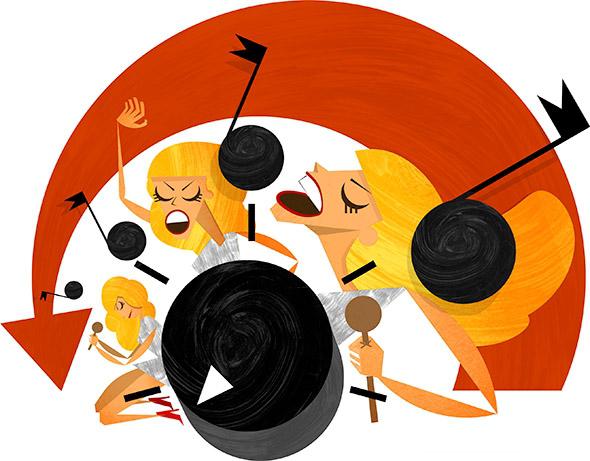
Illustration by Rob Donnelly
The once-ubiquitous, but tragically underappreciated fade-out in music appears to be most its end. And like a archetype example of itself, the decline has been long, gradual, and barely noticed.
The fade-out—the technique of ending a song with a ho-hum decrease in volume over its final few seconds—became common in the 1950s and ruled for iii decades. Among the yr-end top 10 songs for 1985, there'due south not one cold catastrophe. But it's been on the downturn since the '90s, and the by few years have been particularly unkind. The year-end top 10 lists for 2011, 2012, and 2013 yield a total of ane fade-out, Robin Thicke's purposely retro "Blurred Lines." Non since the '50s have we had such a paucity of fade-out songs.
Composer Gustav Holst understood the ability of the fade-out and employed one of the showtime at a 1918 concert. For the "Neptune" section of The Planets, Holst had the women'due south choir sing in a room offstage. Toward the end, he instructed, the door should be closed very slowly: "This bar is to be repeated until the sound is lost in the distance." Given the bailiwick matter—Neptune was thought to be the well-nigh afar planet in the solar system—Holst's attempt to conjure the remoteness of the planet and the mysteries of the cosmos makes sense. Early on fade-outs on record similarly ascribed existent-world scenarios, like the passing railroad train of George Olsen'due south 1930 song, "Beyond the Blue Horizon."
Back when recording was strictly mechanical, in which the vibrations of sound waves straight created the grooves on discs or cylinders, information technology took heroic efforts to end a recording with a fade. Patrick Feaster, an ethnomusicologist at Indiana Academy Bloomington who specializes in the preservation of early sound media, says doing so usually meant slowly carrying the phonograph abroad from the sound's source. He points to an 1894 Berliner Gramophone record, the "Spirit of '76," every bit an early case—on the recording, we hear a fife and drum ring seemingly approach and then march away.
Advances in technology played a large part in the rise of the fade-out. Electric recording emerged in the 1920s, assuasive studio engineers to increment or subtract amplification. And achieving the upshot became fifty-fifty easier when magnetic tape recording became widely available in the '40s and '50s. Many early on fade-outs were added simply because engineers were short on time: To meet the demands of radio, or the limited runtime of 1 side of a vinyl single, they had to make the record fade out early on.
At some point, studio engineers establish that the fade-out could also be used for dramatic event. Just every bit audiences came to take sounds on tape that had no existent-globe equivalent, like multitracking and artificial reverb, they came to hear the fade-out as some other tool in the sonic arsenal. Recording became recognized equally an art form in itself and non just a manner to document live operation. Classical music—even when composed afterwards the phonograph's invention—is still rooted in the prerecorded era and the essence of jazz is in live performance. So you don't hear the fade-out as much in either of those circles. But the recording studio gave popular musicians new avenues for song endings, and eventually they began to take reward.
The Beatles are a adept example of this. Every bit Ian MacDonald points out in Revolution in the Head, the Beatles preferred cold endings throughout their career, but they became more than open to the fade-out later they stopped touring in 1966. No longer burdened by the need to recreate their songs onstage, they got a lot more creative with their endings, and it was during this period that they recorded some of the all-time great fade-outs.
Arguably the about famous ending in pop belongs to "A Solar day in the Life." Although the final, apocalyptic chord rings for more than than 40 seconds before fading to silence, it probably doesn't authorize as a proper fade-out. (Technically, it was sort of the opposite—they extended the chord by slowly lifting the volume faders.) Only the finale of "Hey Jude" meets the criteria, with its repeating chorus and artificially reduced volume (the entire coda takes an impressive four-plus minutes to wind downwards). There's also the fake-out fade of "Helter Skelter" that sounds like information technology'south nearly to close down, only to recharge to total volume before crashing to an end.
The fade-out oftentimes gets dismissed every bit the lazy way out. But the best ones oftentimes deploy slight change-ups to recharge the listener'southward attention milliseconds before all goes silent: the music box sounds introduced over the ethereal fade-out of 10cc'due south "I'm Not in Love," for instance, or the bass flutes that take unexpected prominence at the cease of "Caroline, No." Information technology tin can even prompt a reconsideration of the song itself. The Talking Heads' "Life During Wartime" fades not on an instrumental groove or a repeating chorus but with David Byrne singing an entirely new verse. Information technology makes you wonder: "Merely how many more lyrics are there to this vocal?" (That is, until an alternate version was released in 2005—non that many, it turns out.)
A skilful fade takes more than a steadily turned knob. Jeff Rothschild, an engineer who has worked with Bon Jovi and Nelly Furtado, explains that the volume must "go down a piffling quicker at get-go, and so it's a longer fade." And and so silence. "That'south what sounds more natural to your ear." Similar its ain miniature limerick, the fade-out has a beginning, middle, and end.
And information technology's when musicians cutting loose. The singer ad-libs (Stevie Wonder is good at this), or the band launches into an extended jam. Turning up the volume at these points is like staying late at a prove subsequently the squares accept gone home to hear the band members play for each other. Done right, the fade-out is a song'south parting gift to the attentive listener. "Thank you for staying 'til the end," information technology says. "Here's a little somethin' for ya."
For Abby, a character in Nicholson Bakery'south 1992 novel Vocalism, songs that fade out sound like a terminal stand in the face of the inevitable: Although the singer fights to be heard "every bit she goes for one concluding high note, total of daring and hope and passionateness and everything worthwhile, she'due south lost, she'south sinking down."
David Huron, of the School of Music and Eye for Cognitive and Brain Sciences at Ohio State University, has struck upon a different interpretation. "With a fade-out, music manages to delay closure indefinitely," he writes in Sweet Anticipation: Music and the Psychology of Expectation. "The 'stop' gesture is replaced past a gesture toward the 'infinite.' " And Huron's notion has some empirical support. Researchers at the music lab of Hanover University of Music in Deutschland recently had music students tap along to the trounce of different versions of the aforementioned song. One ended with a fade-out, another with a cold catastrophe. Listening to the cold catastrophe, they stopped tapping an average of 1.four seconds before the song's end. Listening to the fade-out, though, their tapping continued 1.04 seconds after the vocal's finish. This suggests that the fade-out allows a vocal to live on beyond its physical self; the listener senses that information technology never truly ends.
So the fade-out offers us promise in the face of death and a sense of the infinite. Perhaps information technology'southward an escape from the physical world, or a bloodshot yearning for all that tin't exist known.
Or a take a chance to hear some dirty words. Mischievous singers accept long used the fade to sneak in some radio-unfriendly ad-libs. If "Offset Me Upward" featured "you'd brand a dead human being come" as the main chorus, it would not accept been a hitting. Only the Rolling Stones go a pass past placing that line simply as the song heads to the fade.
And so why has the fade-out fallen out of favor?
Permit'due south commencement consider the field of psychology. Although it seems to take been with u.s.a. forever, the notion that we require closure in our lives only gained traction in the 1990s. The Demand for Closure Scale was developed in 1993. This, equally it turns out, is about when fade-outs started losing ground to songs with cold endings—or, yes, closure. Is it a stretch to blame the American Psychological Association? Perhaps.
Permit'south shift our accusatory fingers, then, to the iPod. That's where our itchy thumbs have been stationed since Apple introduced the device in 2001. With a mere depression of the fast-forward button to get to the side by side tune, why wait out those last dwindling seconds? "Information technology'southward all well-nigh that," says Itaal Shur, a songwriter and producer who co-authored the Santana striking "Smoothen" (nice guitar jam in the fade-out). "Nosotros're living in a skip culture." Forget near the last seconds of a song, Shur says—go to a gild and y'all likely won't even get to a vocal'south third verse before the DJ goes on to the next tune. Music is now all about the build-upward, he said. Once it hits a peak, fourth dimension to motion on. (Our attention spans might deserve more credit: A Calgary, Alberta, radio station adopted a format in August promising "twice the music in half the time" by editing songs down to near two minutes each. The format was abandoned weeks afterwards after a backlash.)
Perhaps the blame lies with new studio applied science. In today's studios, new editing tools have made information technology easier to fix mistakes, Shur said. For producers who (wrongly, in my interpretation) view the fade-out equally only a cop-out, they can now patch in a "proper" catastrophe with the click of a mouse. If Beatles producer George Martin had Pro Tools, "Strawberry Fields Forever" might not have that beginning fade-out (he used it to mask a flub), one of most memorable parts of a smashing vocal.
Of course, the answer could be more than simple. Perhaps songs stopped fading for the same reason we stop wearing certain styles of vesture—that is, the mysterious caprice of the collective consciousness.
"As shortly as it becomes the way to practice it, that'south the way to do it," Shur says. "And people don't even know why." A style slowly falls out of fashion, and earlier y'all know it, information technology's gone.
Source: https://slate.com/culture/2014/09/the-fade-out-in-pop-music-why-dont-modern-pop-songs-end-by-slowly-reducing-in-volume.html
0 Response to "What Do You Call It When a Song Stops and Starts Again Slowly"
ارسال یک نظر