On plagues, judgement, and the Book of Revelation
 Is God using the Covid-19 virus and the ensuing crisis to punish people and bring them to repentance? Two voices I have read recently are quite clear that the answer is 'Yep'.
The showtime comes from Adam Young, writing on the Church Guild blog. He begins with an event cited to prove that God does not exercise meticulous control over disastrous events:
Before this twelvemonth the house of American politico Tony Perkins was destroyed in a flood. This would be hardly worthy of hitting the news, were it non for the fact that he had previously said that natural disasters were God'southward judgement on America for supporting same sex spousal relationship. Newspapers love a good bit of irony. It does rather beg the question though—was he right? As Anglicans how should we view the sovereignty of God in relation to weather condition, dearth, disease, or plagues?
Young so reviews some of the prayers in the Volume of Common Prayer, petitioning God in fourth dimension of disaster, and notes the way that these prayers, reflecting on biblical episodes, link the disasters with sin, judgment and punishment.
Nearly every one of these x prayers links the natural disaster in view to sin and rightly-deserved judgement. These natural disasters are something that "we for our iniquities have worthily deserved" and that "we exercise most justly endure for our iniquity." They are instruments of a God of "wrath" through which we are "for our sins punished" and "justly humbled."
Young moves quite rapidly on to summarise a position known as 'meticulous providence' in which the earth is understood to be under the complete control and sovereignty of God.
The God portrayed in the Bible and shown in the doctrine contained in these prayers is a God who is absolutely and totally sovereign over everything. Not a sparrow falls to the footing without His knowledge and His say-and so. Weather condition is completely under His control, as is affliction and sickness. If we are to ever requite thanks that someone survived safely during an earthquake or hurricane, or a flood missed our church, we must accept God was in control of every aspect of the earthquake, hurricane, or flood.
The first trouble with this article is that Young does not answer the question that he sets up. If God is in 'absolute and sovereign control' of disasters, then God must indeed have wanted to alluvion the house of Tony Perkins, presumably because Perkins was sinning and in fault—in his view that God used natural disasters to punish sinners! Unsurprisingly, this is nothing new as a challenge to Christian thinking in this surface area. The Lisbon earthquake of 1755 took identify on All Saints' Day, which meant that many people were gathered in churches, and many more died as a result of church buildings collapsing on them. Was this God's volition? In the Spanish Influenza pandemic of 1918–nineteen, the Bishop of Zamora in Kingdom of spain called people to defy health warnings, and pray and attend mass for 9 days 'to placate God'south legitimate anger'. This included kissing a relic of Saint Rocco (the saint of plague and pestilence) leading to massive cross-infection, and it resulted in the highest bloodshed charge per unit in Spain (12.1% compared with three.8%). Was this God's will?
This questions are raised for us acutely at a personal level too. A friend online commented to me:
I've looked at this subject field a lot – I was built-in as the result of rape…was that God? Was it in 'his programme'? I believe He redeemed it. I had a childhood from hell – was that ordained by God? I was a neonatal nurse – I worked with many babies who died….some 'allowed' to die: God's plan or homo's design? I work with kids asking if God caused their disability – if he did, they don't want to know him. At present, I accept bright autistic children (who don't read) asking why God 'allowed' the virus – not proficient for their mental health.
These are historic period-former questions, and they defy a simplistic answer.
A 2nd instance of this position is articulated by Peter Saunders in a CMF web log post.
Nosotros know that God is utterly sovereign over everything that happens in the universe. As the book of Daniel reminds u.s., kings cannot rule, lions cannot seize with teeth and fire cannot burn down without his permission. God is sovereign over all things human being, biological and physical and especially the ascension and fall of nations (Daniel 2:21, 4:25, 5:21). God was the author of the plagues of Egypt in Exodus 7-12 and is equally the writer of the plagues described in the book of Revelation.
Saunders looks at the plagues described in the Old Testament and notes that they are described as being caused by God:
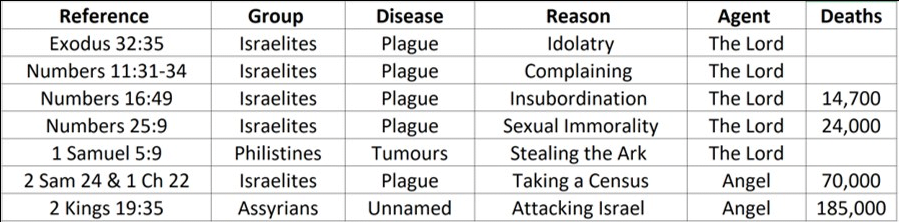
He then extrapolates from that to infer thatall disasters must therefore be directly inflicted by God, and for the purpose of punishment and calling to repentance. Saunders and so relates that to who is being judged:
It is interesting that this epidemic seems to be pain rich Western countries the virtually. That, in general terms the oldest and most wealthy of us on the planet are currently being hit the hardest.
In this I call back he is completely mistaken: information technology is uniformly the poor who are e'er affected more past these disasters—fifty-fifty if the rich perceive themselves to be the near affected, merely considering they focus on their own concerns. In that location is no doubt that those who rushed to the supermarkets and hoarded food will be the last to run out if there are food shortages. So is God encouraging this behaviour, and judging those who are dull to follow their example?
What I find foreign in both these approaches is the lack of attention to what the residue of Scripture says virtually the human relationship betwixt events in the existent world and the will of God—and for the biblical writers, as much as for united states of america, this was a taxing field of study with which they constantly wrestled. Even the bourgeois evangelical site The Gospel Coalition blog manages to point this out:
Nevertheless, the Scriptures do not always connect sickness to specific personal or corporate transgressions. For example, the great prophet Elisha who raised the Shunammite'south son and healed Naaman of leprosy himself fell sick with a terminal disease (2 Kings 13:14). In the New Testament (NT), Jesus corrects his disciples' neat-and-tidy cause-and-effect reasoning that ties physical sufferings to personal sins (Luke 13:1–v; John 9:1–3).
Just we tin become further: in that location is a massive theme within the biblical text that wrestle with the question of why the worldis not the fashion God intends it to be:
I envied the arrogant when I saw the prosperity of the wicked. They have no struggles; their bodies are healthy and strong. They are complimentary from mutual human burdens; they are not plagued past human ills. (Ps 73.3–v)
If we reverse that psalm's numerals and look at Psalm 37, nosotros are offered an answer—only the answer isnot that God exercises meticulous control over all events, information technology is that God exercisesultimate control. His intentionwill exist exercised and fulfilled, at some pointing the future, and human mortality ultimately brings judgement to united states of america all. Thus our response to this disparity is to wait in patience for God'south will to be revealed.
The ultimate instance of this is the Book of Chore, relating to us the theological and philosophical wrestlings of a man who was righteous and yet afflicted, obviously past God. It is Task's comforters, who offered a direct connection between Job'due south sin and his suffering, who are rebuked by God specifically considering they had not spoken truly. Still, frustratingly, the story of Task doesn't offering a bully resolution, and we are left with a mystery. Equally another friend of mine reflected:
I think ultimately we tin't fully fathom the mystery, because we are "in time" and of express and finite minds whereas God is exterior time and of infinite listen… Then I'yard happy to come to a betoken where I say "This much I know…" and trust that is all I need to know for now, from God's betoken of view – because he hasn't told united states everything…
Scripture does tell us some things quite conspicuously, but that doesn't mean information technology offers us packaged answers to these hard questions. I don't think we need to conclude that Scripture is contradictory here either; there are unlike theological traditions within Scripture which sit together, and as nosotros form our understanding of biblical theology, we need to take all these strands together (reading canonically, that is, with the whole of scripture in view). The paradoxes and tensions are rather neatly summed upwards in Jesus' own teaching in Matthew. The Jesus who tells us that 'non one sparrow falls to the ground without your Father knowing it' (Matt 10.29) is the same Jesus who reminds the states that God 'makes the lord's day rise on the evil and the good, and the rain to fall on the just and the unjust'. In other words, you cannot measure sin and righteousness by the events of life!
I commented concluding year on this very question when it came up in the lectionary reading of Luke 13. In respond to the supposition that the Galileans 'deserved' their fate at the hands of wicked Pilate, or that the Jerusalemites 'deserved' their deaths at the hands of whimsical fate, his reply is the same: an emphatic 'No, I tell you!' twice over. We see the same dynamic in the other episode mentioning Siloam, John 9, the episode of the man born blind:
Every bit he went forth, he saw a human being blind from birth. His disciples asked him, "Rabbi, who sinned, this human or his parents, that he was built-in blind?" (John 9.1)
Jesus' answer there is emphatic: 'Neither!' Joel Greenish puts it like this:
It is true that Deut 28–xxx (to proper noun only ane example) insists that judgement will overtake those whose lives are characterised by disobedience, just this is not the same thing as arguing that disasters come only to those who are disobedient. In fact, Jesus' reply does not deny sins its consequences, nor that sin leads to judgement; instead, he rejects the theory that those who encounter cataclysm take necessarily been marked out past God as more deserving of judgement that those who practice not. (NICNT p 514)
In doing this, Jesus isboth acknowledging the unpredictability of disaster—but at the same time refusing to allow become of the notion that we are morally responsible agents.
Holding these two themes together raises some big theological issues. One is the question of the 'openness' of God to events in the world. Does God predetermine everything, and practice meticulous control over everything that happens? Or is God relationally engaged in the world and human affairs, and working with u.s.a. to determine its course? Roger Olson has commented that open theism triggered the "near significant controversy about the doctrine of God in evangelical idea" in the late 20th and early 21st centuries—and the Wikipedia commodity on this is surprisingly good. For a biblical defense of the 'openness' position, I attach hither a chapter expounding it by Richard Rice—but might well return to this in a hereafter post, as information technology is such a large and important bailiwick.
Richard Rice Openness
But information technology as well connects with our undertaking of eschatology and the kingdom of God. In his provocatively-titled article, 'God is not in control', Tim Gombis expounds the New Testament agreement well:
While God remains sovereign king, God'due south sovereign kingship is not being manifested in the creation that is his temple, considering his image-bearers are not manifesting it. Every bit Paul says in Romans 8, creation has been subjected to futility in the hope that it will also be released from the slavery of corruption when God too transforms his people into complete image-bears that manifest his rule. Until then, creation groans and suffers pain (Rom eight:twenty-22). And we practice, besides.
God was not content with this situation and then he came into his earth, took Sin and Death into himself and broke their enslaving grip over his world. And God has promised that he is bringing almost a future new cosmos that will be completely free of the devastation and chaos caused past Sin and Death. All those who call upon God in Christ will inhabit that future world and relish a reality characterized by shalom and approval—the wonder of universal flourishing.
Nosotros do not accept guarantees in this world, except that God will ane day transform his creation. In that location are no guarantees that everything will work out equally nosotros want it to. We will experience suffering, hurting and loss.
In Hebrews 2:v-9, the writer portrays this state of affairs. Humanity was created with glory and honor—God'due south prototype—and God subjected the cosmos to humanity. But we do not currently see everything subjected. This means that creation is in a condition that is out of command. Humanity is non fulfilling its charge to subdue creation and to bring virtually its flourishing.
"Yet at present nosotros do not see everything subject to him (i.e., Jesus, the true human)" (Heb 2:viii)
Just in Christ, God has provided a time to come hope. The future earth is one that is purified of Sin and Death considering Christ is already ruling over it. That future globe is the new creation that this world will one day become. Past faith, Christians are to meet this reality and hope in it .
I think this is exactly what we discover in the Volume of Revelation. The visions John has are not of some serial of hereafter judgements that God will, in the 'end times', ruthlessly inflict on the world, simply a vision of the future in the lite of present reality. John is already, in Jesus, experiencing both 'kingdom' merely besides 'tribulation', and that demands that he lives with 'patient endurance', something he encourages in his readers (Rev ane.ix). If you think the four horsemen of Rev 6 are simply going to gallop out in the 'stop times' at the climax of history, so you cannot be reading the newspapers or known annihilation about history! The figures of conquest, warfare, disease, famine and death are ones that John's readers would accept known well, living in a globe where life was hardhearted and short, and in a function of the world where earthquakes were common and plagues frequent.
John is very conscientious about the way he describes these disasters. God is indeed thede jure sovereign of the world. And and then the four horsemen ride, ultimately, at his command. But John is reluctant to describe these equally meticulously commanded or controlled by God. The are released when the lamb on the throne breaks a seal on the curlicue, and one of the living creatures around the throne calls out 'Come!' to summon them. The moment when Goddoes practise meticulous control is at the time of the coming of the New Jerusalem, in chapter 21, when, without whatever intermediaries, God 'wipes every tear' from our eyes (Rev 21.iv).
And this tension, betwixt ultimate control and penultimate suffering, is seen throughout the book, and most sharply in the central chapters of Rev 12 and 13. In chapter 12, Jesus wins the decisive victory over Satan, expelling him from heaven and freeing his followers from whatsoever allegation or ultimate suffering. And withal in chapter 13, immediately post-obit, Satan stands on the earth, exercising his 'short time' of power, and making the beasts who serve him bruise the saints, something that, once once again, calls for 'endurance'.
God is sovereignde jure, just he is non nevertheless sovereignde facto, in that much of the globe does not recognise or submit to his demanding nonetheless gracious rule. That is why Jesus describes Satan as the 'ruler of this world' who is 'cast out' by Jesus' death on the cross (John 12.31, using language very like to Rev 12), and Paul calls him the 'prince of power of the air' in Eph 2.2. That is why it is our daily prayer that 'You name be honoured, your kingdom come, your volition be washed'. This futurity orientation to the reign of God, nowadays in our lives, but not yet manifest in the earth, is central to Christian discipleship.
So is there whatsoever sense in which God is bringing sentence to usa, to the world, in the spread of this pandemic? Yes indeed—as Paul depicts in Romans 1.18, God'south wrathis being revealed in our reaping the consequences of our decisions. The coronavirus raises the question of our ain fragility and mortality so that we might consider what is truly important. When life does return to 'normal', we will exercise well to have evaluated which parts of 'normal' are worth retaining.
Proximity to decease always has this judging, sifting and evaluating effect on us. (The NT Greek discussion for 'judgement' iskrisis, from which we get our work 'crisis'. The proximity of death, and the realisation of our bloodshed, does indeed provoke in us an existential crisis.) The 'Last Word' column in Friday'southThe Week tells the story of Claire Nelson, a travel writer who fell and was stranded in the Joshua Tree desert in California, and was rescued at the point of decease after four days.
'I was writing travel articles and living in London, which had e'er been the dream,' she says. She had spent years striving for this, just information technology didn't make her happy. She felt solitary, and nether constant pressure to show everyone—friends, family, colleagues—she was living her very best life. 'I concluded upwards in an awful cycle where I became depressed,' she says. Cheers to social media Nelson was able to keep her low subconscious. She could 'put on a mask' and present an image of her life every bit perfect. 'I was very lonely and suffering, and those weren't things I was admitting to anybody. And then my Instagram was a style of hiding that. You tin can put out the best version of you, even if it is not the full version.'
After her close brush with death…
…her Instagram is now more open and honest, and she finds she has more perspective on life. 'I've got this second chance at life. So, how much of information technology do I want to give over to worrying about things that don't matter?'
More than 520,000 people die each yr in the Great britain, which is nearly 1,500 a 24-hour interval—and yet we mostly ignore this reality. With the reporting of Coronavirus deaths (which are very small by comparison), we are being made more aware of our mortality. Would that this volition make the states think almost 'the things that do affair'—and even come to trust in the one who has triumphed over death by his resurrection?
Individually, it brings judgement to our own personal responses: will we respond with honey for neighbour, even if that involves self sacrifice, as the saints before usa accept washed; or at the other extreme will we abandon others to a lonely death, as has happened already at to the lowest degree in one case.
In the Britain, the virus is forcing us to confront the reality of how much we have valued our health service—and how much we have valued those who provide our essential services of bones medical provision and food supply.
In the West more than widely, the pandemic is bringing judgement on our cocky-centred culture, where our decisions are based on what we want, rather than on social solidarity.
Globally, the virus is bringing judgement on our assumptions of interconnection and the correct to travel, despite the cost to the environment. Ironically, it will force us to adopt the measure that climate campaigners have been urging on us which we have listened to with reluctance.
C S Lewis commented on the importance of pain, without attributing to God the cause of our hurting:
Nosotros can ignore even pleasure. Just pain insists upon beingness attended to. God whispers to us in our pleasures, speaks in our censor, but shouts in our pains: it is his megaphone to rouse a deaf world.
We would do well to listen.
If you plant this commodity helpful, share it on social media, maybe using the buttons on the left.Follow me on Twitter @psephizo.Similar my page on Facebook.
Much of my work is done on a freelance basis. If yous have valued this post, would you considerdonating £1.20 a calendar month to support the production of this blog?
If you enjoyed this, do share it on social media (Facebook or Twitter) using the buttons on the left. Follow me on Twitter @psephizo. Like my folio on Facebook.
Much of my piece of work is washed on a freelance basis. If you accept valued this post, you tin make a single or repeat donation through PayPal:
Comments policy: Practiced comments that appoint with the content of the postal service, and share in respectful fence, can add real value. Seek starting time to sympathize, then to exist understood. Brand the most charitable construal of the views of others and seek to larn from their perspectives. Don't view fence every bit a disharmonize to win; address the argument rather than tackling the person.
Source: https://www.psephizo.com/biblical-studies/on-plagues-judgement-and-the-book-of-revelation/
0 Response to "On plagues, judgement, and the Book of Revelation"
ارسال یک نظر